Let your first draft be messy
Writing advice I give all the time…and still forget to take
When you feel stuck, it’s not always about ideas
I’ve been stuck on an essay for my book this week. Actually, the last few weeks.
Not because I don’t have ideas. I actually have quite a few. But every time I sat down to write, I’d get a few lines in, maybe a paragraph, and then stop.
It didn’t feel clear enough. It didn’t feel ready. I couldn’t quite figure out what I was trying to say, and so I kept hesitating.
The writing advice I give (but don’t always follow)
Which is interesting, because this is something I talk to writers about all the time.
Just write it all. Don’t worry about structure yet. Don’t try to make it good.
And then there I was, doing the exact opposite—trying to sort it out before I wrote it, trying to make it make sense too early.
I think sometimes I convince myself that if I just think about it a little longer, I’ll find a clearer way in. A better starting point. A version that already feels organized.
That didn’t happen. And honestly, it rarely does for me.
What changed when I let the draft be messy
What finally shifted things was catching myself in the middle of it.
Oh. Right. I’m doing the thing again.
So I tried what I usually suggest to other writers. I sat down and wrote everything I could think of—every example, every angle, every half-formed idea—without worrying about how it fit together.
I didn’t stop to organize it or clean it up. I just let it be what it was.
Why messy first drafts actually work
The result was a complete mess.
It’s too long in places. It repeats itself. There are sections that won’t make it into the final piece at all. (Don’t worry, I’m saving them for other pieces.)
But it’s also the first version that actually contains something I can work with.
I can see a thread now. There’s a direction emerging. This is something I can begin to shape and refine.
It’s not better in the way I usually want writing to be better. It’s not polished or clear or complete. But it’s usable. And right now, that’s what matters.
As Anne Lamott has famously said: You cannot edit a blank page.
A reminder for writers (including me)
I keep relearning this.
I don’t get stuck because I don’t have ideas. I get stuck because I try to make them make sense too soon.
The first draft isn’t where things come together. It’s where you get enough on the page to discover what you’re actually trying to say.
Then, you work with that.
A small practice to try
If you’re feeling stuck on something right now, try this:
Set a timer for 10 minutes and write everything you might want to say about your piece. Don’t stop to organize it. Don’t reread as you go. Just keep your hand moving (or your fingers typing).
When the timer ends, step away for a few minutes. Then come back and read through what you wrote, not to fix it, but to notice.
What’s repeated?
What feels important?
Where does your energy seem to be?
You don’t need a clean draft to move forward. You just need something to respond to.
If you want support with this
If you need a place to write like this—messy, unfinished, in progress—I run Writing With Friends a few times a week.
You don’t have to have it figured out first. You just have to show up and write.
Erica
PS–When you sign up for my weekly-ish newsletter, you’ll receive a free writing resource on how to strengthen your writing in 15 minutes. Sign up here.
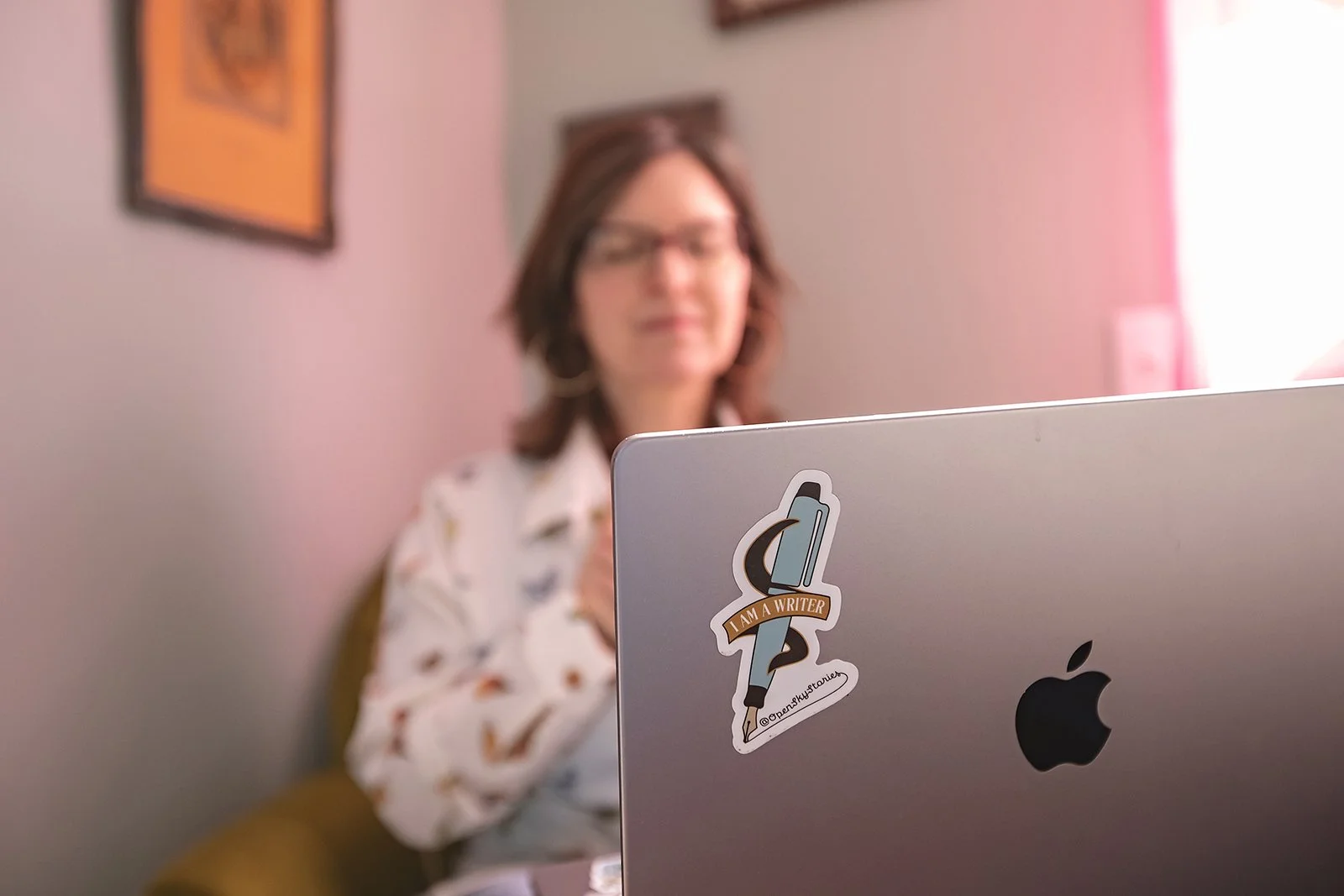
Hi, I’m Erica.
I’m an author, writing coach, and founder of Open Sky Stories. I write children’s books that help kids explore feelings and relationships, including Pixie and the Bees and Pixie and the Fox, and I’m currently working on a creative nonfiction manuscript called Yelling at Dead People. I also lead workshops and offer mentorships to help writers find safety, clarity, and confidence on the page. I live with my muse—an 18-year-old cat, Lucy who insists on supervising every word I write.
